Nigeria
Nigeria is situated in the West African region and lies between longitudes 3 degrees and 14 degrees and latitudes 4 degrees and 14 degrees. It has a land mass of 923,768 sq.km. It is bordered to the north by the Republics of Niger and Tchad; it shares borders to the west with the Republic of Benin, while the Republic of Cameroun shares the eastern borders right down to the shores of the Atlantic Ocean which forms the southern limits of Nigerian Territory. The 800km of coastline confers on the country the potentials of a maritime power. Land is in abundance in Nigeria for agricultural, industrial and commercial activities.
National Anthem
1. Nigeria, we hail thee, our own dear native land,
Though tribes and tongues may differ, In brotherhood we stand
Nigerians all, and proud to serve, our sovereign Motherland.
2. Our flag shall be a symbol, That truth and justice reign,
In peace or battle honoured, And this we count as gain,
To hand on to our children, A banner without stain.
3. O God of all creation, Grant this our one request.
Help us to build a nation, Where no man is oppressed,
And so with peace and plenty, Nigerians may be blessed.
National Pledge
- I pledge to Nigeria my Country
- To be faithful, loyal and honest
- To serve Nigeria with all my strength
- To defend her unity
- And uphold her honour and glory
- So help me God.
Key Data
Government
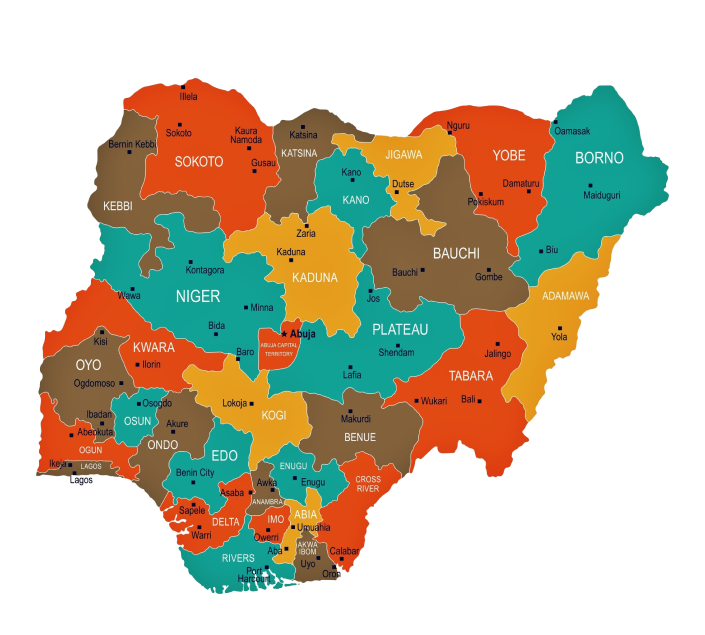
Three-tier structure – A Federal Government, 36 State Governments, 768 Local Government Administrations and 6 Area Councils of the Federal Capital Territory of Abuja.
Main Religion
Traditional Beliefs, Christianity, Islam
Main Commercial/Industrial Cities
Lagos, Onitsha, Kano, Ibadan, Port Harcourt, Aba, Maiduguri, Jos, Kaduna, Warri, Benin, Calabar
Main Ports
Lagos (Apapa, Tin-can Island), Warri, Port Harcourt, Onne Deep Sea and Hub Port, Calabar (EPZ)
Main Airports
Lagos, Kano, Port Harcourt, Abuja, Enugu, Kaduna, Maiduguri, Ilorin, Jos, Owerri, Calabar, Yola, Sokoto
Road Networks
Over 15,000 km of intercity all weather paved roads, including dual carriage express trunks.
Railways
2 main lines (South-West to North-East; South-East to North-West) inter-linked and terminatory at Lagos, Port Harcourt, Kaura Namoda, Maiduguri and Nguru. Major junctions at Kaduna, Kafanchan, Zaria. Gauge: 1067mm; Total length 3505 route km.
Energy
Hydro-electric: Kainji, Jebba, Shiroro. Thermal and Gas: Egbin (Lagos), Ughelli, Afam, Sapele, National grid for electricity distribution; National pipeline network with regional depots for petroleum products distribution; National network (pipeline) for distribution of gas (under construction).
Other Data
Geography, Climate & Vegetation
Geography
Climate
Vegetation
Population & Labour Force
Nigeria is famous for her huge population of about 140,003,542 as at March 2006 – the largest national population on the African continent. This population is made up of about 374 distinct ethnic stocks. Three of them, Hausa, Ibo and Yoruba are the major groups and constitute over 40 per cent of the population. In fact, about 10 ethnic linguistic groups constitute more than 80% of the population: the other large groups are Tiv, Ibibio, Ijaw, Kanuri, Nupe, Gwari, Igala, Jukun, Idoma, Fulani, Edo, Urhobo and Ijaw. The gender divide of Nigeria’s population, as indicated by the last census in 1991, reflects an unusual unbalance in favour of male dominance; 51% male: 49% female.
However, the more critical population indices concern:
- High growth rate – 3.2%; this is affected by decreased infant mortality andhigh fertility.
- High school age population – over 47% are 15 years and below.
- High child dependency ratio – one dependant to one worker for the working age group 25-65.
- Large work force – working age group 15-59 is over 40 per cent of the population.
Due to a massive expansion in the education sector in the last two decades, the coloration and quality of the Nigerian work force has changed to include a large corps of highly trained personnel in mechanical, civil, electrical, electronics, chemical and petroleum engineering and biotechnics. There are at present over 30 Federal and State Universities, some of them specialist – Technology and Agriculture. In addition there are at least 20 Federal and State Polytechnics. Over 70,000 graduates in various disciplines from these institutions every year. Disciplines, apart from pure sciences, engineering and technologies, include social sciences, business studies (management, banking and finance), architecture, environment and urban management studies. Also, a sizeable Nigerian population has been and is being trained outside the country, in some of the best colleges in the United States, Canada, United Kingdom, Germany, France, Russia, Japan and China. Every year, about 2,000 of these Nigerians return home to seek employment or accommodation within the economy. For the less skilled and unskilled labour, the country depends on the primary and secondary school systems whose annual enrolments are over 3.5 million and 1.5 million, respectively.
Resources: Agriculture, Minerals & Marine
Nigeria, in addition to its huge population is endowed with significant agricultural, mineral, marine and forest resources. Its multiple vegetation zones, plentiful rain, surface water and underground water resources and moderate climatic extremes, allow for production of diverse food and cash crops. Over 60 per cent of the population is involved in the production of the food crops such as cassava, maize, rice, yams, various beans and legumes, soya, sorghum, ginger, onions, tomatoes, melons and vegetable. The main cash crops are cocoa, cotton, groundnuts, oil palm and rubber. Extractions from these for export and local industrial use include cocoa flour and butter, rubber crumb, vegetable oil, cotton fibre and yarn. The rain forests have been well exploited for timber and wood products of exotic and popular species. Oil and Gas, by value, are the most important minerals. They are exploited and produced in the Niger Delta basin and off-shore on the continental shelf and in the deep-sea of the territorial waters. Nevertheless, there are significant non-oil mineral deposits on land many of which have been identified and evaluated: coal, iron ore, gypsum, kaolin, phosphates, lime -stone, marble, columbine, baryte and gold.
The Economy
Know about our Economy
Read more >>